The Mother Wound Part Four: Grieving The Mother You Lost Before She Died
When the final goodbye comes after years of waiting, hoping, and letting go
Grief can be complicated, especially when it comes to a mother we’ve already emotionally let go of before her death. For many of us, the mourning began years earlier-through boundaries we set, conversations that never happened, or the painful recognition that reconciliation might never come.
When the final goodbye arrives, the emotions can be confusing: numbness instead of tears, relief mixed with guilt, or a quiet ache that feels familiar yet impossible to fully name. This part of the series is for those navigating the delicate space of loss after loss, learning how to move forward when the relationship we longed for can never be restored.
There’s a unique kind of grief that comes when we lose someone we had already lost a long time before.
For many, the relationship with our mother may have been marked by distance, pain, or unmet needs. We may have grieved her absence for years – even while she was alive. We may also have practiced how it would be when the day that came, when she was no longer physically present. So, when the final loss comes, it often feels different than you or others expect.
I felt numbness instead of tears, a clear and sharp awareness of what had happened but without the emotions, you see I had already spent them all over the past 27 years without her. Others might feel relief, confusion, or guilt for not grieving in the “right” way. And some feel the familiar ache resurface, deeper than ever before showing as hurt, regret, anger and blame.
If this is your story, you are not broken. You are simply navigating a grief that began long before death.
“At a certain point we must face that our mothers could not and will not meet our needs in all the ways we needed and wanted her to. This must be grieved all the way through.”
When Reconciliation Isn’t an Option
One of the hardest truths of the mother wound is accepting that reconciliation isn’t always possible. Sometimes estrangement, deep patterns, or illness create walls too high to climb. And when death closes the final door, the “maybe someday” that you’ve hung onto all your life disappears with it.
This was my experience. For years, even though I’d closed the door as tight as I could, I carried a quiet hope that one day my mother would see me, choose me, or love me differently. When she died, I realised the waiting was over. In that realisation, something unexpected happened: alongside numbness was a sense of sadness and freedom, and this created deep confusion within me.
That’s not the end though – It’s hard for others to understand the pain and loneliness underneath what looks like a lack of care or love. It’s easier for people to morn in the way society dictates and judge or ignore those who don’t.
There needs to be more awareness of the pain of never having had your grief acknowledged when it was happening, in the same way others are afforded that as a part of ‘standard’ mourning process. I felt invisible as the waves of hurt and disappointment from unconscious remarks and actions of people around me seemed to negate my existence and my pain in the context of what was happening.
Then there is the all-important question and the one I toyed with for years, and there really was no right answer for me, I would be damned whatever I did. So I chose me – I didn’t go to the funeral.
Everyone is different and should be afforded that choice without judgment. The internal, messages started to resurface “you don’t deserve love, or support” feeling a familiar sense of punishment for choosing to be loyal to myself. This hurt me a lot and caused more confusion, more pain and more family division feeling like the initial wave of heart ache all over again.
Stopping the Cycle
There is also a need to consider here the ancient pattens still unconsciously play out. When a mother passes, families often unconsciously seek someone to “take her place.” Without even realising it, daughters may quickly step into the matriarch’s role.
These unconscious patterns stem from ancient survival needs, where the matriarch ensured the continuity of family and community. But today, stepping into that role without choice or awareness will trap you in cycles of self-sacrifice and silence.
The healing work begins with noticing the pattern, asking, “Am I choosing this, or am I repeating it?” and then giving yourself permission to redefine what leadership, care, and legacy mean on your own terms. I know have created a new legacy for my family going forward, one of love and encouragement and authentic growth and one we are proud of.
Remembering these ancient practices reminds me that the mother-child bond has always been sacred – but also that healing today means rewriting what we expect of mothers and daughters and what and how we allow ourselves to grieve.
“Until you make the unconscious conscious, it will direct your life and you will call it fate.”
— Carl Jung
Tools That Helped Me, and Now Help Others
“Healing the mother wound is not about blaming your mother; it’s about taking personal responsibility.”
— Bethany Webster, Discovering the Inner Mother
Here are some of the ways I moved through this stage of grief – and the practices I now share with others facing the same:
Creating a personal goodbye. Write an unsent letter, light a candle, plant something living. Rituals give the body a way to mark what words or conversations never could.
Holding Gratitude and Truth Together
This helped me to acknowledge both what my mother gave me and what she couldn’t because of her own life experiences. Mapping my own life experiences and considering hers not only helped me see my own pattens it helped to understand that life is not black and white.
Gratitude did not erase the truth-and truth didn’t cancel out the gratitude. Both could exist side by side.
The endless hope for change keeps us stuck. Death can feel final, but it also ends the waiting. That space can be filled with your own life, your own choices.
Many people carry guilt-for walking away, setting boundaries, or not reconciling before the end. Healing often means forgiving yourself for what you did to survive, protect yourself, or find peace. The practice of Ho oppono ponno is one I share often. A simple prayer acknowledging us as the centre of our own happiness.
Continuing Bonds in a New Way
Even without reconciliation, you can still choose how the relationship lives on inside you. For me, that meant allowing my mother to remain part of my story without letting her pain define my future.
Some continue a quiet dialogue- through journaling, prayers, or speaking to a photograph. Others choose peace through distance. There is no right or wrong – only what brings you peace and freedom.
When you’ve already grieved someone before their death, the final goodbye feels like an ending, but it was also an invitation. An invitation to choose yourself fully.
To stop waiting. To lay down what no longer serves. To create a new legacy where love, connection, and safety are built differently.
Because even without reconciliation, healing is still possible. And in many ways, it is here-in the space beyond waiting-that we find our truest freedom.
“When we are no longer able to change a situation, we are challenged to change ourselves.”
— Viktor Frankel
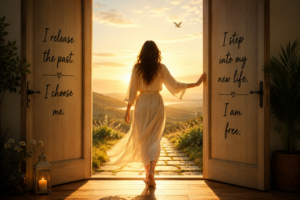
The journey may have brought you face-to-face with grief, boundaries, and the truths you couldn’t change-but it also opens a door to something new.
What comes next is about choice: choosing yourself, reclaiming your voice, and stepping into a life that is no longer defined by old wounds. In the next part of this series, we’ll explore resetting your future – how to carry the lessons, release the patterns, and intentionally create a life that reflects your true self, free from the limits of the past.
Want to know more?
Drop me a message – I’d love to hear your story